
Financial abuse isn't just about arguments over money. It’s a calculated pattern of control where someone uses finances to dominate and trap another person, making them feel completely powerless. The most common signs of financial abuse are things like cutting off access to money, deliberately wrecking someone's career, and forcing them into debt. Learning to spot these behaviors is the first real step toward getting your freedom back.
What Financial Abuse Really Looks Like
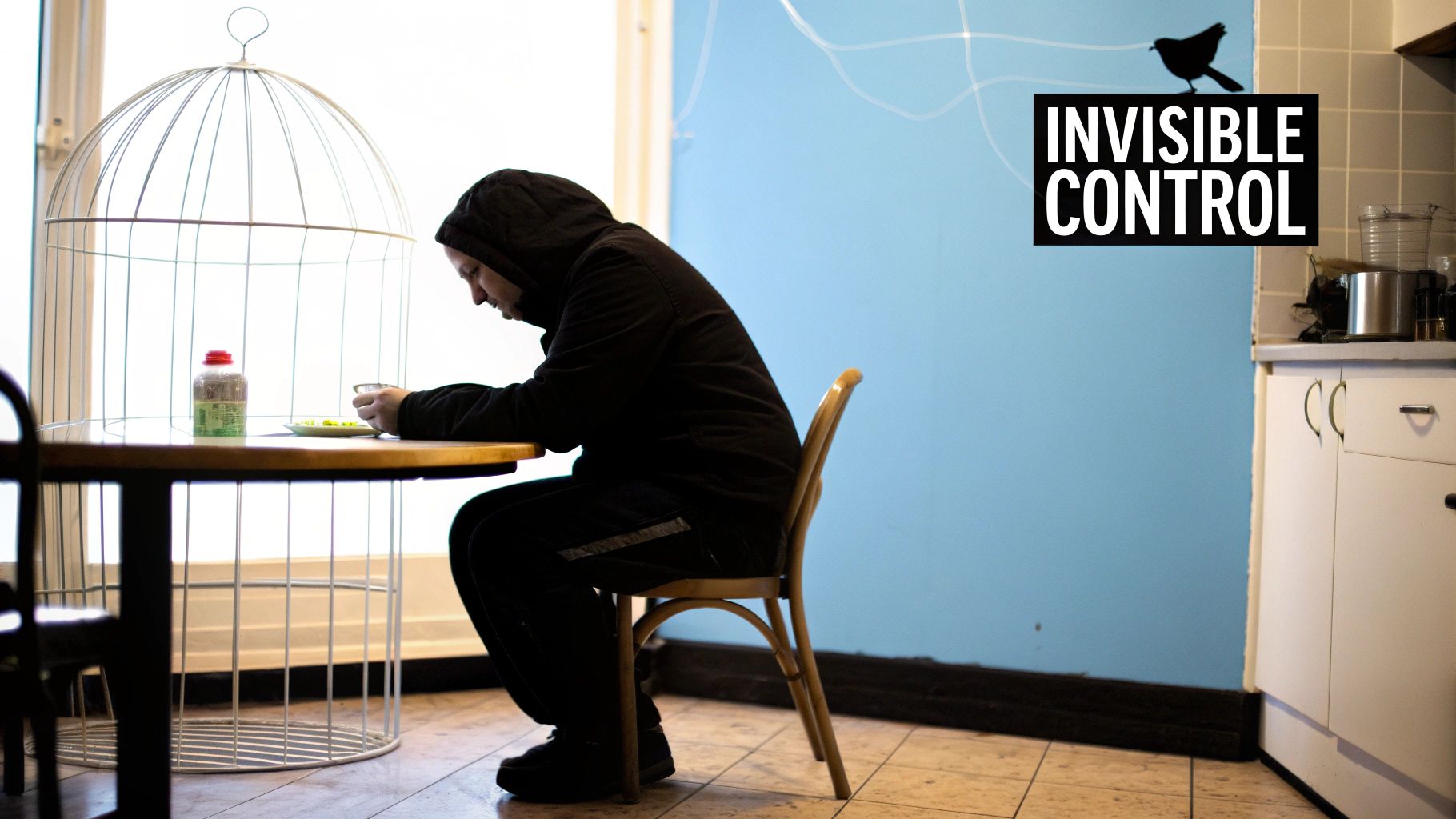
At its core, financial abuse is a form of coercive control that chips away at a person's ability to live their own life. Imagine an invisible cage, but instead of iron bars, it’s built with financial tactics. The abuser’s ultimate goal is to make their partner, parent, or child so utterly dependent on them that they lose the ability to make their own choices—or even think about leaving.
This kind of abuse rarely starts with a bang. It often creeps in quietly, maybe even disguised as being helpful. A partner might insist on handling all the bills to "take the stress off you." But over time, that "help" slowly transforms into a rigid system of control where you're locked out of your own bank accounts, forced to explain every dollar you spend, or even stopped from having a job.
The Abuser's Playbook
Once you understand the strategies behind financial abuse, the signs become much easier to see. Abusers generally stick to a few key plays designed to isolate their victim, create fear, and build a powerful sense of dependency.
To help you recognize these patterns, we can break them down into three core pillars.
The Three Pillars of Financial Abuse
| Category of Abuse | What It Looks Like (Examples) |
|---|---|
| Financial Restriction and Control | * Limiting your access to bank accounts or credit cards. * Giving you a strict "allowance" despite your income. * Forcing you to justify every single purchase. |
| Employment Sabotage | * Preventing you from going to work or job interviews. * Causing disturbances at your workplace to get you fired. * Demanding you quit your job to be a full-time caregiver. |
| Coerced Debt and Exploitation | * Taking out loans or credit cards in your name without consent. * Forcing you to sign financial documents you don't understand. * Stealing your identity, assets, or inheritance. |
These tactics are all designed to dismantle a person's financial foundation, making escape feel impossible.
The Broader Impact of Financial Crime
These deeply personal acts of abuse are just one piece of a massive global problem. The financial crime epidemic is staggering, with estimates showing that over $3.1 trillion in illicit funds flow through the financial system every year. This massive figure covers everything from large-scale money laundering to the kind of individual exploitation seen in financial abuse. While organized crime is a huge driver, a significant amount comes from personal fraud and financial manipulation that completely shatters lives. You can learn more about the scale of financial crime from this report.
Financial abuse is fundamentally about power. By controlling the finances, the abuser controls the victim's ability to live, work, and even think independently. It traps them in a state of manufactured helplessness.
Recognizing these patterns isn’t about placing blame. It’s about seeing the situation for what it truly is: a deliberate strategy of control. By understanding these tactics, you can start to see if what you’re going through is more than just a money disagreement—it’s a serious form of abuse.
Spotting the Behavioral Red Flags of Control

Financial abuse almost never starts with a drained bank account or a forged signature. It’s far more subtle than that. The roots are usually behavioral, growing from small actions that are easy to brush off as a personality quirk, overprotectiveness, or even a sign of love. These early red flags are designed to test your boundaries and quietly build a foundation of control.
An abuser might frame their control as an act of care. For example, they could insist on managing all the household finances just to "make life easier for you." While it's perfectly normal for partners to divide up chores, this crosses a line when it becomes a system where you have zero visibility, no input, and no access to your own money. The "help" becomes a cage.
That distinction is everything. A healthy partnership thrives on transparency and shared decisions, even if one person handles the daily bill payments. In an abusive dynamic, one person holds all the financial power, and the other is intentionally left in the dark.
Weaponizing Guilt and Incompetence
One of the most potent tools in an abuser’s arsenal is psychological manipulation. They often work tirelessly to convince you that you're simply not capable of managing money yourself. It's a slow, insidious process that erodes your self-confidence until you start to believe it, too.
You might hear phrases like:
- "You're just not good with numbers. Let me handle it."
- "Remember that time you overspent? It's just better if I manage our budget."
- "You're too emotional to make smart financial decisions."
This constant stream of criticism creates a story about your own incompetence. The abuser positions themselves as the logical, responsible one, which only reinforces your dependency on them. They might also use guilt to make you feel selfish for wanting to be involved or for questioning their control. Asking to see a bank statement could be met with a wounded, "Don't you trust me?"
This tactic is about creating a psychological dependency that mirrors the financial one. By convincing you that you are incapable, the abuser makes it feel safer to surrender control, trapping you further.
This issue is a global crisis. Gender-based economic violence is a rampant form of financial abuse that affects millions. Statistics show that roughly one in three women have experienced intimate partner violence, which very often includes economic control. This type of abuse is a powerful way to isolate victims by controlling their money, sabotaging their employment, or trapping them in coerced debt. You can explore the full research on intimate partner violence and its economic impact to better understand the scale of the problem.
Isolating You From Your Career and Support System
Another clear behavioral sign of financial abuse is a systematic effort to cut you off from your income and your support network. This doesn't always look like a blunt demand to quit your job. It's often far more subtle and damaging over time.
An abuser might:
- Show intense jealousy or resentment toward your career success, making you feel guilty for doing well.
- Constantly create drama or "emergencies" that force you to miss work or leave early.
- Criticize your colleagues or boss, attempting to poison your professional relationships.
- Insist you prioritize their needs over your career, often framing it as a noble sacrifice for the family.
This behavior is designed to isolate you, making the abuser your one and only source of financial stability and social connection. By dismantling your professional life, they eliminate your path to independence. It's crucial to recognize these subtle forms of sabotage, as they are often the first steps toward complete financial control. The emotional toll can be staggering, requiring dedicated support, a topic often discussed by mental health professionals who work with abuse survivors.
Finding the Hard Financial Evidence
While those unsettling behaviors are often the first red flag, financial abuse almost always leaves a paper trail. This is where things get real. Finding the evidence shifts your concern from a gut feeling to a set of cold, hard facts that can't be denied.
Think of yourself as a detective piecing together a case. You're looking for the clues in bank statements, credit reports, and official documents that just don't add up. This hard evidence is the language that banks, courts, and support agencies understand. It's your most powerful tool for breaking free.
Control Over Assets and Information
One of the most direct ways an abuser operates is by cutting off your access to money you have a right to. This isn't just strict budgeting; it's a complete takeover of financial control, and the proof is often hiding in plain sight.
Keep an eye out for these specific signs:
- Sudden Password Changes: You're suddenly locked out of the online banking or investment accounts you’ve always had access to.
- Missing Financial Mail: Important documents like bank statements, bills, or tax forms stop showing up, or you realize they're being intercepted before you ever see them.
- Unexplained Withdrawals: You notice large sums of money have vanished from joint accounts, or you see a pattern of small ATM withdrawals you know you didn't make.
- Your Name Disappears: You find out you've been taken off a joint bank account, a property title, or even a utility bill without any conversation or consent.
The goal here is to keep you in the dark. By controlling what you see, the abuser makes sure you can't make informed decisions, question their actions, or even grasp your own financial situation.
Sabotaging Your Job and Income
An abuser knows that your job is your ticket to independence. By attacking your ability to earn a living, they make you more and more dependent on them. This kind of sabotage is a calculated effort to make you unemployable or to simply take the money you work so hard for.
The concrete evidence often looks like this:
- Redirected Paychecks: Your direct deposit is suddenly rerouted to an account you can't get into.
- Stolen or Cashed Checks: Physical paychecks go missing from the mail or are cashed without your signature.
- Demands for Your Income: You're forced to hand over your entire paycheck as soon as you get it, only to be given a tiny, restrictive "allowance" from your own money.
These aren't just isolated incidents; they are deliberate moves to dismantle your financial self-sufficiency, one piece at a time. The abuser's goal is to become the sole gatekeeper of all money coming into the household, which tightens their grip.
Coerced Debt and Financial Fraud
Perhaps the most devastating tactic is coerced debt. This is when an abuser uses your name and good credit to get money for themselves, leaving you with a ruined financial future. It’s a toxic mix of deception, forgery, and fraud that leaves you legally on the hook for debts you never agreed to.
This isn't a small problem. Recent data from the Federal Trade Commission is alarming, showing consumer fraud losses skyrocketed to over $12.5 billion—a 25% jump from the year before. This surge was fueled by a sharp increase in people losing money to scams, especially sophisticated investment and job-related fraud. The data shows just how advanced and damaging financial exploitation has become. You can dig into these concerning trends in financial fraud from the FTC.
The evidence of coerced debt is usually unmistakable:
- Unauthorized Credit Accounts: You start getting bills for credit cards or store accounts you know you never opened.
- Mysterious Loans: A collection agency calls you about a personal loan, car loan, or even a mortgage that was taken out in your name without your knowledge.
- Forged Signatures: You discover your signature has been forged on checks, loan applications, or other legally binding financial documents.
- Damaged Credit Score: Your credit score takes a nosedive because of missed payments on fraudulent accounts, which can make it nearly impossible to rent an apartment, get a real loan, or move forward with your life.
Uncovering this kind of evidence can feel like a punch to the gut. It's shocking and overwhelming, but finding these concrete signs is the first, most critical step toward proving what’s happening and getting the help you need to make it stop.
Creating Your Safety and Action Plan
Just realizing you're in a financially abusive situation is a huge, courageous step. But what comes next? Acting on that knowledge has to be done carefully and strategically. This isn't about making big, sudden moves that could put you at risk. It’s about quietly laying the groundwork for a safer future.
Think of it as taking back control, one small, deliberate action at a time.
Most importantly, please know that none of this is your fault. Financial abuse is a calculated tactic used to maintain power and control. Your only job right now is to focus on your safety and well-being. If you are ever worried about your physical safety, your very first call should be to a domestic violence hotline for immediate guidance.
Secure Your Digital and Physical Documents
The first practical step is to create a secure inventory of your life. An abuser often controls information to maintain power, so gathering your own copies of essential documents is a crucial act of reclaiming your independence.
Start by discretely collecting and making copies of important paperwork.
- Personal Identification: Gather your driver’s license, birth certificate, Social Security card, and passport. Don't forget copies for your children, too.
- Financial Records: Collect bank statements, tax returns from the last few years, pay stubs, and any loan or mortgage documents you can find.
- Proof of Assets: Make copies of property deeds, vehicle titles, and statements for any retirement or investment accounts.
Find a safe place to store these copies, completely away from your home. A trusted friend or family member's house is a good option, as is a safe deposit box that only you can access. You could even use a secure, password-protected digital folder. The goal is to have everything you need to prove your identity and financial history when you are ready to act.
This flowchart can help you visualize how to connect specific controlling behaviors to concrete evidence of abuse.
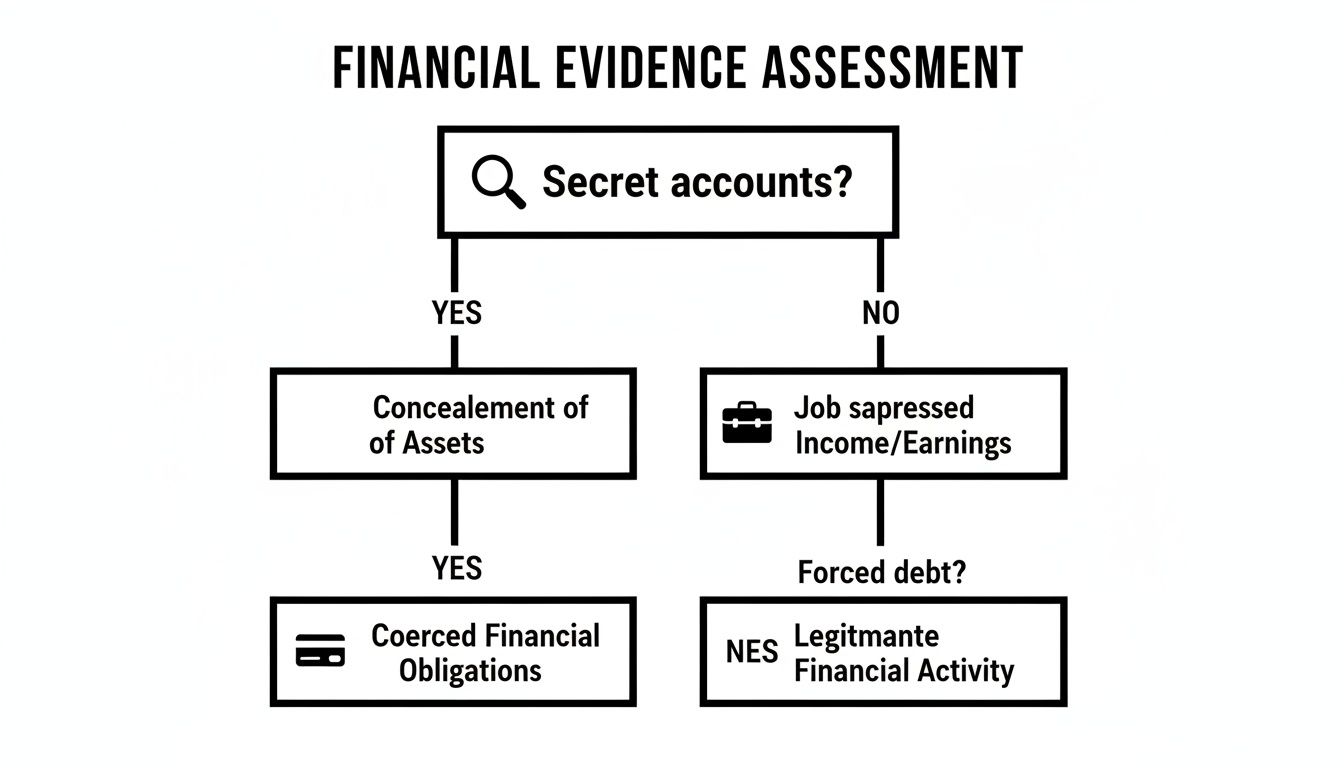
By asking pointed questions—about secret accounts, interference with your job, or debts you were forced into—you can start building a case with tangible proof.
Build Your Independent Financial Foundation
Creating a financial space that is entirely your own is a powerful move toward freedom. It gives you a safe place to build resources that your abuser can't touch or even see. This must be done with extreme care and privacy.
- Open a New Bank Account: Go to a completely different bank—one you have no shared history with—and open a new checking and savings account. Make sure you are the only person on the account and opt for paperless statements sent to a new, secure email address.
- Establish a PO Box: Never have mail for your new account sent to your home. Use a PO Box or the address of a trusted friend or family member instead.
- Secure Your Digital Access: It's time to change the passwords on all your personal accounts: email, social media, and any online financial portals. Use strong, unique passwords and turn on two-factor authentication wherever you can.
- Check Your Credit Report: You are entitled to a free copy of your credit report from all three major bureaus (Equifax, Experian, and TransUnion). Get them. Go through each one line-by-line, looking for accounts or debts you don't recognize. This is one of the most common signs of financial abuse.
This isn't about hiding money; it's about creating a lifeline. Having your own secure account gives you the ability to save funds and prepare for a future where you make your own financial decisions.
Each of these actions is a building block for your new life. They might feel small, but together, they create a solid foundation for financial independence. Remember to move at your own pace and always put your safety first. Don't hesitate to reach out to legal aid services or a domestic violence advocate for extra support as you navigate this.
How to Support Someone Facing Financial Abuse
It’s heartbreaking to watch someone you care about slowly lose their confidence and independence. When you start to suspect financial abuse is the cause, your first instinct might be to jump in and fix everything. But your role isn't to be a rescuer. It's to be a steady, non-judgmental ally. The goal is to empower them to reclaim their own power, not to make decisions for them.
Broaching this subject is incredibly delicate. The person you're worried about is likely tangled in a web of shame, fear, and maybe even a misplaced sense of loyalty to their abuser. Coming in too strong with accusations will probably just make them shut down. Instead, your job is to create a safe, welcoming space for them to talk—if and when they feel ready.
Starting the Conversation with Empathy
The most effective way to open this conversation is with concern for them, not criticism of their partner. Frame your observations around their well-being. This small shift makes it clear you’re in their corner, no matter what.
You could try a few gentle, open-ended questions to get started:
- "I've noticed you seem really stressed about money lately. Just wanted you to know I’m here if you ever want to talk about it."
- "It seems like you have to ask for permission to spend money, and I was just wondering how that feels for you."
- "I’m worried about you. You're one of my favorite people, and it feels like you've been under a lot of pressure lately."
Your tone and your patience are everything here. They might not open up the first time you ask, or the second, or even the tenth. What matters is that they know the door is always open and you are a safe person to turn to when the time is right.
Your role is to listen more than you speak. Avoid bad-mouthing their partner or judging their choices. Simply validating what they're feeling with phrases like, "That sounds incredibly stressful," or "I'm so sorry you're going through that," can make all the difference.
Offering Practical and Safe Support
Beyond just listening, you can offer tangible help that respects their autonomy and, most importantly, keeps them safe. Never forget that financial abuse is often intertwined with other forms of control and can escalate quickly, so being discreet is crucial.
Here are a few practical ways you can lend a hand:
- Offer a Safe Place for Documents: You could offer to securely hold copies of their important papers—ID, birth certificate, bank statements, passports. Having a backup they can get to easily is a vital part of any safety plan.
- Help with Research: Offer to look up local resources for them, like domestic violence shelters, legal aid clinics, or credit counselors. You can gather the phone numbers and websites and pass them along without any pressure to act.
- Provide Access to Technology: An abuser often monitors their partner's phone and computer. Offering them the use of your device to make private calls or research an escape plan can be a game-changer.
- Be a Consistent Ally: Sometimes, the most powerful thing you can do is just be a reliable, trustworthy friend who shows up without judgment.
For professionals—counselors, lawyers, financial planners—learning to spot the subtle signs of financial abuse is a critical responsibility. Simply providing a client with information on specialized support services can be a life-changing intervention. If you're looking to deepen your skills in this area, learning more about trauma-informed care training can provide the framework you need to support victims effectively and ethically. Your support can be the lifeline that helps someone begin their journey back to safety and independence.
Rebuilding Your Financial Future After Abuse

Walking away from an abusive relationship is an incredible act of courage. The road ahead is about more than just finding safety—it's about reclaiming your financial independence. This isn't an overnight fix; it's a journey that requires patience, a ton of self-compassion, and the willingness to be kind to yourself as you navigate what comes next.
Think of it like building a new home for yourself, brick by brick. Your foundation is a new budget, one that’s secure and reflects your income and your needs. This isn't about pinching pennies or restriction. It’s about empowerment. When you know where your money is going, you regain the power to direct it, creating the stability and control you absolutely deserve.
Taking Control of Your Finances
The very first step is to get a crystal-clear picture of where you stand financially. It’s time to take stock of what you earn, what you spend, and what you owe. Once you have that clarity, you can begin making deliberate choices that build the future you want.
Right now, your focus should be on these key priorities:
- Creating a Simple Budget: Start by listing every source of income and all your essential expenses—things like rent, utilities, and groceries. This gives you a baseline to work from.
- Reviewing Your Credit: Get free copies of your credit reports. You need to look for any accounts or debts that were opened without your knowledge so you can start the process of disputing them.
- Establishing Financial Independence: If you haven’t done this yet, make sure you have a bank account solely in your name. Have the statements sent to a secure address or email that only you can access.
This early stage is all about carving out a safe financial space for yourself. Every single action, no matter how small it might feel, is a massive step toward rebuilding your life on your own terms.
Reclaiming your financial future is an act of defiance and resilience. It's a declaration that you are in control of your own story and that your future will be one of security and strength.
Finding Resources and Repairing Your Credit
Facing a credit report damaged by abuse can feel overwhelming, but fixing it is entirely possible. The first move is to dispute fraudulent debts with the credit bureaus and the creditors themselves. Filing an identity theft report can be a powerful tool to back up your claims. This takes persistence, so keep a detailed record of every phone call, email, and letter.
At the same time, seek out trustworthy financial literacy programs. Many non-profits and local community organizations offer free workshops on everything from budgeting and credit repair to saving strategies. These programs offer more than just practical skills; they connect you with a community of people who truly understand what you're going through. You don’t have to do this alone.
Remember, the journey to financial stability is a marathon, not a sprint. Celebrate the small wins—creating your first solo budget, getting an incorrect item removed from your credit report. Each victory reinforces your own strength and brings you one step closer to a future defined by empowerment and security. A future that you control.
Common Questions About Financial Abuse
It's completely normal to have a lot of questions when you're trying to figure out if what you're experiencing is financial abuse. The lines can feel blurry, especially when you're in the middle of a difficult and painful situation. Let's clear up some of the most common points of confusion.
What's the Difference Between a Money Fight and Financial Abuse?
Every couple and family disagrees about money at some point. That's just part of life. A healthy disagreement might be about whether to save for a vacation or pay down debt. Even if it gets heated, the goal is usually to find a solution together through communication and compromise. Both people have a say.
Financial abuse is something else entirely. It's not a disagreement; it's a pattern of controlling behavior where one person systematically uses money as a tool for power.
The real difference comes down to intent. Is the conflict about a specific financial issue, or is it about one person using money to manipulate, isolate, and dominate the other? Forbidding a partner from working, forcing them to justify every penny spent, or making them feel afraid to even bring up the topic of money—that’s not a disagreement. That’s abuse.
Think of it this way: are financial discussions used to build a partnership, or are they used to enforce a power imbalance? If money is consistently used to chip away at someone's freedom and independence, that's a clear sign it has crossed the line.
Can Financial Abuse Happen Outside of a Romantic Relationship?
Absolutely. While we often hear about it between spouses or partners, financial abuse can crop up in any relationship where one person has power or influence over another.
Here are a few all-too-common examples:
- An adult child slowly drains an elderly parent's retirement accounts or pressures them into changing their will.
- A caregiver withholds funds from a person with a disability, leaving them unable to pay for essential care or personal items.
- A business partner methodically cuts their partner off from company accounts to steal profits and take over the business.
The dynamic, no matter the relationship, is the same. One person exploits a position of trust to take control of someone else's financial life, effectively robbing them of their autonomy.
I See the Signs, but I'm Terrified to Leave. What Should I Do?
Feeling scared is a completely natural and valid response. Your safety is the number one priority, and you need to know that packing a bag and leaving isn't always the first or safest move. The immediate goal is to start quietly building a safety plan.
Start by reaching out to a domestic violence hotline or a local support agency. They are trained experts who can provide confidential, non-judgmental advice that fits your specific circumstances.
If you can do so safely, begin to discreetly collect important documents—your ID, birth certificates, Social Security cards, and any bank statements you can get your hands on. It’s also wise to try and squirrel away small amounts of emergency cash in a place the abuser would never think to look.
Most importantly, do not confront the abuser or announce your plans to leave. This can escalate an already dangerous situation. For now, your focus should be on secretly lining up support and gathering the resources you'll need.
If these warning signs are hitting a little too close to home for you or someone you know, the next step you take is critical. At Babette Wilson, we're here to provide resources that inform and empower.
Start by downloading our Financial Abuse Warning Signs checklist to get more clarity on your situation and discover pathways to help. For a deeper understanding of the complex dynamics of control and the journey to resilience, explore the books available at https://babettewilsonauthor.com.
Generated with the Outrank tool

Pingback: dapoxetine sildenafil
Pingback: metoprolol succinate er
Pingback: ciprofloxacin ophthalmic solution
Pingback: rogaine minoxidil for women
Pingback: viagra denver
Pingback: cenforce 50 side effects
Pingback: cenforce soft 100 mg
Pingback: sildenafil for dog
Pingback: udenafil online
Pingback: semaglutide hoeveel afvallen
Pingback: metronidazole for dogs uses vomiting
Pingback: terbinafine mechanism treatment overview
Pingback: amoxicillin drug basics
Pingback: Peak Concentration Overview
Pingback: Sildenafil Cmax Shift
Pingback: Absorption and Distribution Variability
Pingback: Sildenafil vs vardenafil half‑life
Pingback: tadalafil for erectile dysfunction